The Price of Mercy
-
((Sneak-peak foreword. There seems to be a discrepancy when viewing through a PC and through a phone or tablet. I have tried to post in different order but it seems that, on phones and tablets, the chapter order gets reversed. I can not do more on my end. I apologise for the inconvience but there is nothing that I can do about it.))

Foreword – The Jewel Reforged
Peltarch had once been called the Jewel of the Icelace.
In those days, the name belonged to a city of pale stone and northern wind. Its walls rose against the cold like the clenched hands of some stubborn old monarch, their towers watching the western roads and the black teeth of the Giantspire Mountains beyond. Merchant caravans arrived beneath armed escort, their wheels thick with mud from the Nars. Ships entered the harbour under patched canvas, carrying salt, timber, iron and stories from coasts most citizens would never see.
The Commons lay open beneath the sky. Traders shouted over one another among canvas awnings and wooden stalls while mercenaries waited beside fountains for work that was rarely honest and never safe. Near the docks, the Dancing Mermaid Inn spilled lamplight, music and the smell of fried fish into the wet streets. Sailors drank beside adventurers. Magistrates drank beside smugglers. Those who entered alone often left with companions, enemies or debts.
City Hall stood above them all, stern and enduring, its chambers filled with councillors, petitioners and clerks who believed ink could impose order upon a city built by refugees, soldiers and opportunists. The Lighthouse Temple burned through snow and sea-mist, guiding ships toward shelter while priests tended those whom the harbour returned broken.
Beneath the streets, the sewers carried away what respectable Peltarch preferred not to see.
The city endured because endurance was what northern cities did.
It survived wars, cults, famine, plague and things that crawled from older ruins with no proper names. Walls were breached and rebuilt. Districts burned and rose again upon their own foundations. Every generation swore that Peltarch could not grow larger without losing itself.Every generation was wrong.
The first engines arrived wrapped in brass and prayer.
They rattled between horse carts, coughed black smoke beneath the city gates and required both mechanics and priests to keep them obedient. Artificers learned to set spellwork inside copper lattices. Dwarven foundries sank deeper beneath the Commerce District. Lightning was taught to remain inside wires. Bound flame heated homes. Speaking crystals became household terminals, then vanished into devices small enough to conceal beneath the skin.
The old walls could not contain what followed.
They were dismantled, absorbed or buried beneath new construction. The West Gate became a customs and transit complex through which thousands passed each hour beneath scanners, warding arches and watchful security spirits. Elevated railways curved above the ancient roads. Glass towers rose from stone foundations, their upper floors disappearing into cloud and rain.
The Commons became a many-tiered concourse flooded with advertisements bright enough to turn midnight into an imitation of day. Food stalls crowded the lower terraces beneath recruitment booths, public terminals and corporate clinics. The old Rant Stand remained, though its weathered platform now stood among broadcast projectors. Anyone could still speak there. Whether anyone heard depended upon which network carried the signal and who had paid to suppress it.
City Hall survived by allowing the new city to grow through it.
Its oldest chambers remained built of carved stone, their floors worn smooth by centuries of argument. Above them rose ministries of mirrored steel, private offices and secured conference levels where corporations negotiated laws before elected officials were invited to discuss them. Armoured lobbyists crossed halls once guarded by men with halberds. The weapons had changed. The function had not.
The Dancing Mermaid endured too.
Her painted wooden sign became electric, then holographic, then neon once nostalgia became fashionable. She still danced above the entrance, blue and silver against the harbour rain. Inside, dockworkers with reinforced spines drank beside data brokers wearing borrowed faces. Street samurai rested swords within reach while smart pistols slept beneath coats. Old blades remained useful in crowded rooms where a bullet might pass through three strangers, rupture a pressure conduit and summon corporate security before the wounded struck the floor.
The docks spread outward over the Icelace on colossal platforms of steel and enchanted concrete. Cargo cranes moved like long-necked beasts through fog thick with exhaust. Autonomous freighters arrived without sails or crews. Beneath them, fishermen still worked from narrow boats, their nets repaired by hand, navigating water illuminated by the chemical glow of runoff from manufactories upstream.
The temples adapted.
The Triad opened hospitals beneath immaculate white towers where artificial organs could be grown, shattered bones rebuilt and death postponed—if the correct authorization arrived in time. The Lighthouse became a navigation beacon for ships, aircraft and orbital traffic, its sacred flame burning behind layers of reinforced glass. Smaller shrines appeared beside elevator motors, under railway arches and inside maintenance tunnels. Incense mingled with ozone. Prayer strips fluttered from ventilation grilles. Old spirits learned the names of new machines and accepted offerings in whatever places people were still afraid.
By then, the city had acquired another name.
Neo-Peltarch.
The Jewel had been reforged into something vertical, dazzling and merciless.
Its highest districts breathed purified air above the clouds. Their streets were quiet, their gardens warm even in winter, and their emergency services arrived before blood reached the pavement. Far below, beneath transit lines and cooling pipes, families lived in apartments where daylight appeared only as a pale reflection between towers. Ambulances crossed those streets with destination priorities already calculated. Medicine existed for almost every wound. Access did not.Rain washed the whole city without discrimination.
It streamed down corporate glass, old temple stone, patched armour and rusted fire escapes. It turned neon into rivers beneath the feet of executives, mercenaries, pilgrims, augmented labourers and children selling counterfeit medication outside clinics they could not enter.
Peltarch remained a city of gates. Some were made of stone. Some of steel. Some of contracts, credit ratings and unpaid insurance.
And beyond each one waited the same ancient question, sharpened for a newer age:
When mercy has a price, who is permitted to live?
-
Chapter 3 — The First Contract
At six forty-three the following morning, the glass doors of Yongming Central opened for the card in Xiulan’s hand. She paused beneath the canopy while rain hissed along the avenue and an elevated train passed overhead. Across the street, someone had placed a cup of tea before a small bronze spirit between a pharmacy and a cybernetic repair shop.
Xiulan touched the prayer wood beneath her sleeve. “Office of Thresholds, this one was told she may return. Please witness that she does so without presumption.”
The doors remained open. She bowed and entered.
The guard at the security desk recognized her. His gaze moved from her face to the spear at her right side. “Back again?”
“This one said she would return.”
“People say a lot in interviews.” He pointed towards the reinforced storage cradle. “Same arrangement. New claim token this time.”
Xiulan surrendered the spear. Blue light passed along its steel head and worn wooden shaft; a fresh token slid from the reader. She tucked it securely beside yesterday’s temporary access card.
“Employee Services,” the guard said. “Twelfth floor. Your card will take you there.”
She thanked him. At the gate the card turned a light from red to green, and a lift arrived before she could look for a button. Its mirrored walls greeted her by name. Xiulan bowed instinctively towards the voice, then stepped clear of the closing doors.
Employee Services was smaller and warmer than the hospital lobby. A simulated forest covered one wall, its leaves stirring beneath sunlight that could not be felt. People waited with document cases, tablets and sleeping children. None appeared surprised by the amount of paperwork required to begin an ordinary day.
A woman in silver-framed spectacles rose from a desk. “Xiulan? I’m Alina Senn, Employment Integration.” She extended a hand, noticed Xiulan’s uncertainty and replaced the gesture with a slight bow.
“This one thanks you for receiving her.”
“Come in. We have a few things to get through. Coffee?”
“This one does not know what coffee is.”
Alina made two cups. Xiulan tasted hers and kept her expression composed, though a muscle beneath one eye tightened.
“That bad?” Alina asked.
“This one does not wish to insult the office responsible for it.”
Alina smiled and opened the employment agreement across her desk. “Fortunately, coffee isn't part of the contract.”
The document unfolded into columns and smaller references. Xiulan could read the Common words, but their combinations were less familiar. Alina noticed her studying a paragraph for longer than the others.
“Would translation help?”
“This one understands many words. Not all meanings.”
“Then we go slowly.”
The position was a six-month clinical traineeship under Emergency Operations. Xiulan would receive language instruction, supervised practice, assessments and training in Yongming’s equipment. She could assist qualified staff, but she could not claim independent clinical authority.
“A healer describes what you can do,” Alina explained. “A clinical title describes what the law allows you to do here.”
“This one will say trainee.” Xiulan considered the training schedule displayed beside the contract. “When may this one begin?”
“If we finish today, this morning. You won’t be going into the field yet.”
“Of course.” Xiulan looked pleased rather than disappointed. “There is much this one must learn first.”
Alina moved on to wages. Yongming would pay her twice a month into an account registered in her name. The money would be hers to spend, rather than an allowance controlled by the people who instructed her.
“For food?” Xiulan asked.
“For food, rent, anything legal.”
“And if this one spends it unwisely?”
“You may regret it, but the choice remains yours.”
Xiulan considered that. In the palace, food belonged to the household until placed in her bowl, and clothing remained the property of those who issued it. Even instruction had been something received on another person's terms. Money that stayed hers was a strange kind of trust.
Other provisions followed: paid leave, rest periods, medical coverage, workplace protections and the right to report unsafe conditions. Xiulan listened closely when Alina explained that she would sometimes be paid while not working.
“Rest is paid?”
“Yes.”
“Even when there are wounded?”
“Someone else covers the shift. The schedule is not yours alone to carry.”
That seemed more remarkable to Xiulan than the wages. She had known healers who worked until their hands shook, then apologized for needing sleep. Yongming did not appear to regard exhaustion as proof of devotion.
Alina covered the rules for ending employment. Xiulan recognized the provision that an employee could resign by giving notice; she had asked Pell about permission to leave the day before. Now the words sat plainly on the page. She did not expect to use them. She had come to Yongming because she wanted to remain.
The final sections concerned housing eligibility, identity support, licensing assistance and specialist programmes. Ordinary training was part of her traineeship. Equipment or additional programmes could require separate service and repayment agreements, explained before acceptance. A company account would record the relevant allocations.
“Does this one owe anything under those arrangements today?” Xiulan asked.
“No. Nothing has been allocated. You'll review any separate schedule when it's needed.”
Xiulan nodded. Instruments cost money, and someone had to keep account of them. More interesting was the timetable. The first lesson concerned clinical monitoring, the second emergency response procedures. She had recognized neither instrument shown beside the lesson titles.
Alina offered her more time and the opportunity to seek independent advice. Xiulan looked once more at the terms. She had asked what she needed to ask. The agreement would allow her to learn, work and help patients under people who understood this city's medicine.
“This one wishes to begin.”
“Then sign when you're ready.”
Xiulan signed.
Alina placed the temporary card against a reader. Its white face darkened to muted blue. The word VISITOR disappeared, replaced by Yongming’s white inward-curling spiral and a new identification record:
YONGMING HEALTH SYSTEMS
XIULAN
CLINICAL TRAINEE — PROVISIONAL
EMERGENCY OPERATIONS
EMPLOYEE ID: YM-047291A small chip caught the light beneath the surface. On Alina's desk, two confirmations appeared: PAYROLL ACCOUNT OPEN and TRAINING INVESTMENT ACCOUNT OPEN — NO RECOVERABLE ALLOCATIONS. Alina cleared them with a practiced movement. Xiulan scarcely noticed. She turned the card in her hand, watching her new title remain visible from every angle.
“Welcome to Yongming,” Alina said.
Xiulan bowed. “This one will make good use of the chance she has been given.”
The office door opened. Ressa stood in the frame with coffee held between the synthetic fingers of her left hand. “Finished teaching her labour law?”
“Employment went better than coffee,” Alina said.
Ressa glanced at Xiulan's untouched cup. “Good judgment. Is she cleared?”
“Provisional and supervised. No specialist schedules active.”
“Good.” Ressa looked at Xiulan. “Ready?”
“This one has been ready since before dawn.”
“Then come on, trainee.”
They passed from the carpeted administrative floor into bright clinical corridors. Ressa walked quickly, and Xiulan kept pace while examining the badge clipped to her clothing.
“You are not a field medic,” Ressa said. “No independent pharmaceuticals, no unsupervised procedures. Spiritual intervention requires consent and authorization. Yesterday was an emergency, not a precedent to follow whenever you think you're right.”
“This one understands.”
“Ask when you don't. I would rather answer a foolish question than write a report about a preventable injury.”
In the changing room, a folded blue-grey uniform waited inside an open locker. The Yongming spiral stood above the word TRAINEE. Xiulan changed and folded her violet travelling clothes carefully. For once she expected to find them undisturbed when she returned.
The sleeves were too long. Ressa folded one cuff, keeping her synthetic fingertips clear of a narrow seam.
“This one can alter it,” Xiulan said.
“Don't. Sensor thread. Sato will fit you properly later.”
“This one thanks you.”
“You will stop thanking me for every ordinary thing.”
“When?”
“Several years after I retire.”
Beyond the next door, training mannequins breathed, bled and produced symptoms on command. One lay beneath a diagnostic frame, a red light blinking beside its throat. Xiulan stepped towards it, then stopped when she saw a sealed instrument whose purpose she could not guess.
“You did well yesterday,” Ressa said. “You also entered a restricted ward and treated someone without credentials. Both things are true.”
“Yes.”
“You don't repay praise by becoming obedient. You repay training by learning.”
Xiulan lifted her gaze. “How does this one earn field duty?”
“By making your first mistakes on patients who can be reset.” Ressa opened the ward door wider. “Start with that monitor.”
The mannequin breathed once, then paused. Xiulan put two fingers against its synthetic wrist. A pulse travelled beneath the skin, swift and thin. Above the bed, three figures changed colour.
“What do you see?” Ressa asked.
“The breath is shallow. The pulse runs too quickly.”
“And the monitor?”
Xiulan studied the figures. She could recognize the warning but not the cause. “This one does not know.”
“Good. Now we have something to teach you.” Ressa touched the display and separated its readings into simpler patterns. She did not remove Xiulan's hand from the wrist. “Start with what you can observe. Then learn what the machine can tell you that your fingers cannot.”
Xiulan leaned closer. The next breath failed. This time she was watching both the patient and the numbers.
That evening, Xiulan returned to the Central Transit hostel with aching feet and a training schedule filled with corrections. Twice she had chosen the wrong instrument. Twice Ressa had made her begin again. There was no shame in remembering the mistakes; tomorrow she would know what to do differently.
Rain crossed the window as a train passed below. Xiulan set the blue identification card beside her schedule, where she would see it in the morning. Wages had not yet arrived, and there were rooms to find and skills to master. None of that diminished what the card meant.
She touched the prayer wood beneath her sleeve and gave thanks to the Office of Thresholds. Tomorrow she would pass through the glass doors not to ask for a place, but to take up the work she had chosen.
-
Chapter 2 — The Office of Returning Breath
The lift descended with none of the violence Xiulan’s body expected. The orderly shifted the cases against his chest, breathing through his mouth. Only then did he glance towards her visitor badge.
“You’re new.”
“Yes.”
“What unit?”
Xiulan looked down at the word VISITOR glowing beneath her name. “This one is uncertain.” His head turned sharply. His mouth opened, but the lift doors parted before he found words. Emergency intake swallowed them.
Noise came first, not chaos, but something more disciplined and therefore more frightening. Forty-three casualties had entered a system built to receive suffering, and the system had opened every mouth at once.
Stretchers moved beneath hanging diagnostic arrays. Wet clothing was cut away and dropped into blood-streaked bins. Trauma teams called numbers instead of names. Transparent tubing carried artificial blood through warming units. A child screamed until a nurse placed both hands around his face and gave him one calm voice to follow.
The orderly thrust his chin towards a supply station. “There.” Xiulan carried the case where he indicated. A medic opened it without looking at her and handed her two sealed bundles. “Respiratory bay.” She followed the direction of his outstretched arm.
At the next station, someone took one bundle and replaced it with a stack of folded thermal blankets. Another voice told her to hold open a door while a stretcher passed.

Nobody asked who she was. For several minutes, usefulness became its own authorization. Xiulan moved where people pointed. She carried oxygen tubing, gathered discarded packaging before it fouled the floor and held a trembling patient’s shoulder while a nurse secured an intravenous line. She understood perhaps half the devices around her, but the bodies beneath them remained familiar. Pain still tightened mouths. Fear still searched every unfamiliar face for certainty. Blood remained blood, however brightly the equipment around it glowed. Then she saw the man beside the wall.He lay on a temporary stretcher between two treatment bays. One side of his coat had been scorched away, though the burns beneath did not appear deep. A clear mask covered his mouth and nose. The monitor above him displayed numbers Xiulan could not yet read.
Two nurses passed him. A physician glanced towards the display, then moved to a patient whose blood was spilling faster. The man’s chest rose. Stopped. Rose again. The rhythm was not simply weak. It was losing its place. Xiulan set down the blankets. She approached the stretcher and bent near enough that he might see her without turning his head. “This one is Xiulan.”
His eyes remained half-open. She waited. A faint movement drew his gaze towards her. “This one must touch your wrist.” His fingers shifted once beneath the blanket. Whether consent or reflex, she could not be certain, but the monitor changed tone and the breath that followed caught halfway. Xiulan placed two fingers over his pulse. It ran quickly beneath the skin, yet there was no strength in it. The rhythm reminded her of someone hurrying along an unfamiliar road after nightfall, certain only that something followed.
“Sir?”
His gaze found her again and then drifted past. Xiulan began to kneel. A hand closed around her shoulder. The grip was firm enough to stop her without causing pain. Ressa stood behind her, rain darkening the collar of her field jacket. A narrow line of someone else’s blood marked her cheek.
“You were told to remain upstairs.”
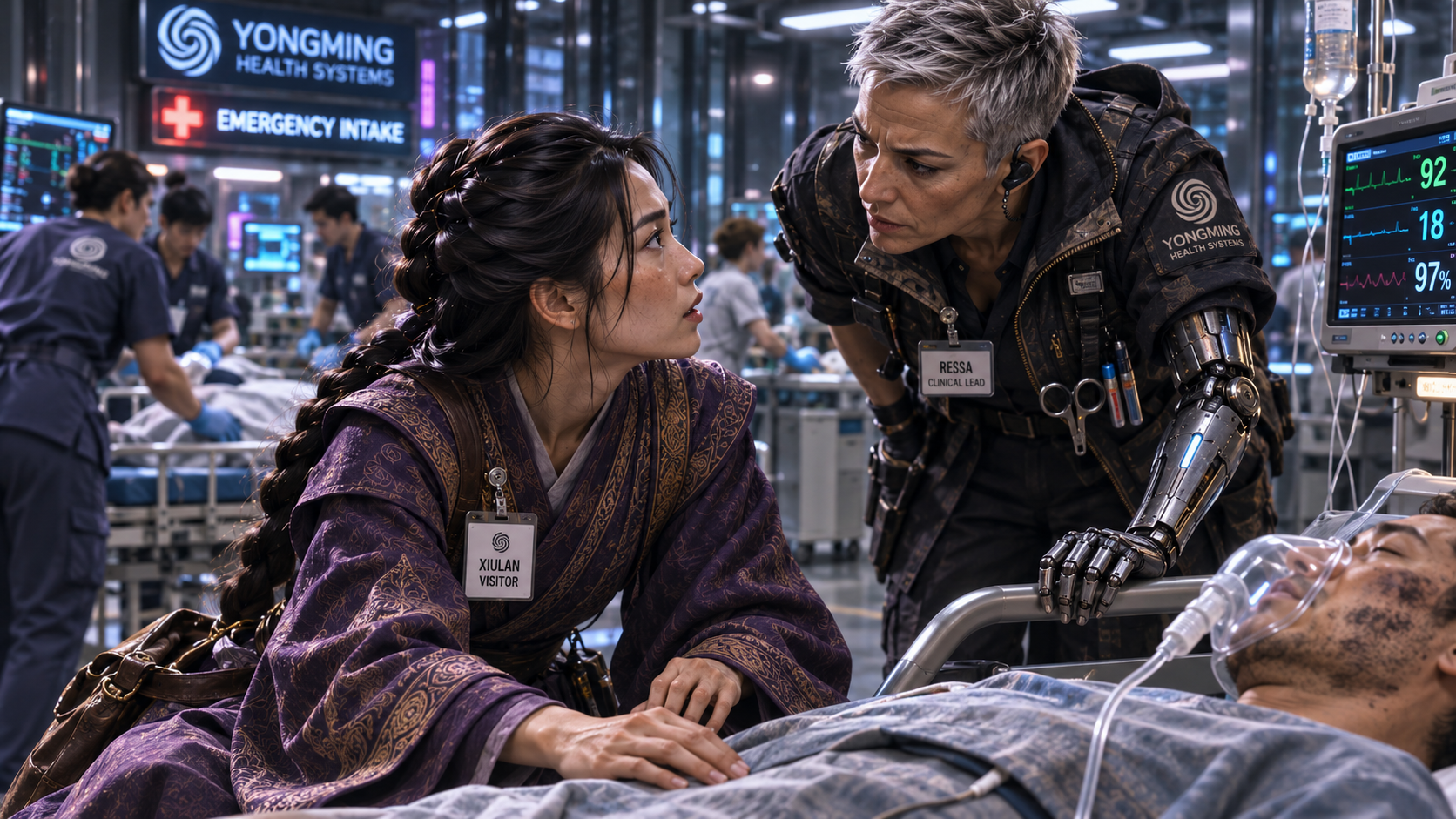
Before Xiulan could answer, the man’s chest rose halfway and stopped. Ressa released her and moved to the stretcher, adjusting the oxygen mask with one hand while the synthetic fingers of the other found his pulse at the throat. The monitor gave another warning. Across the bay, a nurse called for respiratory support, but no one reached them immediately.“Yes,” Xiulan said. Her apology had formed at once, complete and practised, but the man’s failing breath held her attention.
“Then why are you here?” Ressa asked without looking up.
Xiulan’s fingers closed around the prayer wood beneath her sleeve. “There are wounded.”
“There are licensed people treating them.”
“Yes.”
“And you are not one of those people.”
The words should have restored the proper order. Xiulan’s posture became straighter, more formal, but her eyes remained fixed on the stretcher. “His breath is forgetting to return.”
“That isn’t a medical description.”
“No.”
Ressa glanced from the monitor to the man’s face. Her hands continued working. “What did you notice?”
Xiulan listened to his breath rather than the machinery. “The pause is becoming longer. His pulse runs, but does not carry him. His eyes are already looking farther away.” Ressa’s mouth tightened. She glanced at the monitor, then back at the man. “Smoke inhalation,” she murmured. “Possible chemical exposure.” She reached for the line connected to his arm and checked the medication seal. Her movements were quick, but not hurried. “Respiratory team is tied up.” Xiulan waited. The pause between the man’s breaths lengthened again.
Ressa looked at her. “Can you help him?” Xiulan’s hand remained beneath her sleeve. “If permission is given.”
“Whose?”
“His, if he can give it.” She swallowed once. “Yours, if this place requires it.”
“And after that?”
“This one asks the office responsible.”
Ressa studied her face. The humour from the interview had vanished. What remained was a hard professional attention made sharper by urgency. She took the patient’s hand. “Sir, squeeze if you consent to treatment.” For several seconds, nothing happened. Then his fingers closed weakly around hers. Ressa released him and stepped aside. “Two permissions,” she said. “The third is your problem.” Xiulan knelt.
She placed one hand lightly over the centre of the man’s chest and the other around his wrist. The hospital moved around them in white light and urgent voices. Someone called for blood. A child cried behind a curtain. An automated system announced that another ambulance had arrived. Xiulan closed her eyes.
The prayer came in Shou, quiet enough that Ressa had to lean nearer to hear it. “Office of Returning Breath, keeper of those movements borrowed and repaid. Witness that this traveller has not reached the end of his road. If offence has been offered, let accounting wait. If merit is lacking, let this one stand as guarantor until morning.”

Nothing shone. No glyph appeared above the stretcher. No spirit announced itself through the machines. The only visible change came through Xiulan. The tension left her shoulders. Her breathing slowed until it matched the rhythm she asked the man’s body to remember. Her thumb rested against his pulse, following each beat without attempting to command it. The monitor continued its uneven alarm. Then one tone changed. The next breath entered deeper. Ressa’s eyes moved immediately towards the display. “Again,” she said, though whether to Xiulan or the patient was unclear. The man’s chest rose. This time it did not falter halfway. A resident physician reached them at a run, followed by a nurse carrying a ventilatory unit. “What happened?”“Pressure’s recovering,” Ressa said. The physician looked at the medication line. “What did you administer?”
“Nothing.”
His gaze moved to Xiulan’s hand over the patient’s chest. “Who is she?”
“Useful,” Ressa answered. “Work around her.” The physician’s lips parted, but the monitor demanded his attention. He fitted new tubing to the patient’s mask while the nurse adjusted the bed. Xiulan ended the petition with a small incline of her head and withdrew her hands. “He still requires physicians,” she said. The returning urgency of the room had entered her voice, but it did not disturb its softness. “Now they possess time.”
The physician looked from her to the monitor. Suspicion tightened the skin around his eyes. “How did you…”
“This one asked.” Ressa made a small sound through her nose. “Later.” The patient disappeared into a treatment bay. Nobody thanked Xiulan. Nobody had time. She preferred it that way.

Xiulan bent to gather the thermal blankets she had left beside the wall. Halfway down, her breath caught. There was no pain. Only the peculiar sensation that the air had stopped before reaching the bottom of her lungs, as it had for the man beneath the mask. She remained still for a moment. The next breath came whole.When she straightened, Ressa was watching her. Her gaze lingered just long enough to make Xiulan wonder whether the pause had been visible.
“Leave those,” Ressa said.
Xiulan obeyed. The older medic had wiped the blood from her cheek with the back of one hand, leaving a faint smear near her jaw. She nodded towards the corridor. “Walk.” Xiulan followed.
They moved through the emergency department while staff worked around them. Ressa did not speak until they reached a narrower passage overlooking the ambulance entrance. Rain hammered the glass beyond it. Red warning lights moved across the wet pavement below as another vehicle approached.
Ressa folded her arms. “You disobeyed Compliance and entered a restricted clinical area.” Xiulan lowered her gaze. “Yes.”
“You touched a patient without licence, credential or documented supervision.”
The formal posture returned fully now: hands folded, shoulders quiet, chin lowered. “Yes.” Ressa watched the transformation. “You become very polite when you expect punishment.” Xiulan’s fingers pressed more tightly together. “This one does not wish to make offence worse.”
“That wasn’t an answer.”
Xiulan raised her eyes cautiously. Ressa’s face held no anger. Nor did it offer reassurance. She simply waited. “Yes,” Xiulan admitted. Ressa looked through the window towards the ambulance below. “Who taught you to recognize respiratory failure?”
“Many Sisters.”
“That answer again.”
“It remains true.”
“Were they physicians?”
“No.”
“Priests?”
“No.”
“Healers?”
“Some.” Ressa rubbed one synthetic fingertip against the knuckle of another. “You don’t separate those things.” Xiulan considered the city reflected in the glass: medical towers, temple spires, advertisement light and rain layered together until none could be viewed alone. “No.”
Ressa’s gaze shifted towards her. “Most people in that room see procedures. They see airway algorithms, pharmaceutical pathways and equipment.”
“These are useful.”
“They are.” Ressa’s expression sharpened slightly, as though the agreement had surprised her. “What did you see?” Xiulan looked back towards Emergency. Through the narrow window in the door, she could see the resident physician adjusting the patient’s ventilator while a nurse secured the lines around him. “A tired man.” Ressa’s mouth moved. Not quite a smile. “I thought so.” They returned to the interview floor after the immediate crisis had eased. The room felt smaller than before.
Pell sat at the table with several new documents open before her. A trace of fatigue had appeared beneath her eyes. Kelm stood beside the window, reading from a display.
Neither invited Xiulan to sit. She remained near the door until Pell noticed. “Please.”
Xiulan took the chair. Kelm turned from the window. “You violated a direct instruction.” His voice remained calm, which made the statement feel less negotiable. Xiulan folded her hands. “Yes.”
“You entered a restricted medical response area while falsely appearing to belong there.”
“No.”
Kelm’s gaze sharpened. Xiulan felt Ressa look towards her. “This one did not claim employment,” she continued. “This one carried what was handed to her.” Pell closed her eyes briefly. Not in anger, Xiulan thought, but in the manner of someone restraining several possible replies. Ressa sat in the chair beside Xiulan rather than returning to her earlier place across the room. Kelm remained standing. “You practised undocumented spiritual intervention on a patient inside a corporate facility.”
“This one asked permission.”
“From an employee without authority to authorize experimental treatment.”
Ressa leaned back. “I authorized emergency assistance while licensed staff were unavailable.”
“You cannot retrospectively credential a stranger.”
“No,” Ressa said. “But I can take responsibility for what happened in my department.” The room grew still. Xiulan looked towards her. Ressa did not return the glance. Her attention remained fixed on Kelm. Pell rested both hands on the table. “We need to determine what, precisely, occurred.”
“A hypoxic patient deteriorated,” Ressa said. “Xiulan noticed before telemetry showed the change. She assisted in stabilizing him until respiratory support arrived.”
“Through an unverified magical mechanism.”
“Possibly.” Kelm’s jaw tightened. “You were present.”
“I was busy keeping him alive.”

“That does not answer the question.” Ressa turned her head slowly. “It answers the important one.” Pell intervened before the silence became confrontation. “Xiulan, what exactly did your petition do?” Xiulan’s gaze moved between them. Every answer seemed likely to offend someone. “This one does not know.” Kelm’s expression hardened. “You performed an intervention whose effects you cannot explain.”“Yes.”
“And you consider that responsible?” Xiulan looked down at her hands. A faint smell of smoke remained on them. “No.” The answer altered the room. Ressa turned towards her fully. Xiulan continued before fear could make her retreat into apology. “It was necessary. Necessary and responsible are not always the same.”
Kelm stared at her. Pell’s fingers stopped moving over the documents. Ressa’s eyes narrowed, not in displeasure but concentration. After a moment, Kelm asked, “Do you routinely ignore authority when you decide your judgment is superior?” Xiulan’s spine straightened. “No.”
“What was different today?” She could feel the prayer wood against her wrist.
“A man was dying.” Kelm waited, but Xiulan did not add anything. Ressa looked away first. Her gaze settled on the rain beyond the glass, and one corner of her mouth tightened as though she had nearly spoken. Pell broke the silence.
“We cannot employ someone as a medic without recognized credentials.” Xiulan inclined her head. The expected disappointment arrived quietly. Her shoulders did not move, but her fingers closed around one another beneath the table. “I understand.”
“No,” Ressa said. “You don’t.” Xiulan looked towards her.
Ressa reached across the table and drew one of Pell’s documents closer. “She can’t be employed as a certified medic. She can be admitted as a clinical trainee under supervision.” Kelm’s attention shifted to her. “On what basis?”
“Observed competency.”
“One incident.”
“Two observations,” Ressa said. “The interview counts.”
“What competency did she demonstrate during the interview?” Ressa rested her synthetic fingers flat against the document. “She knows what she doesn’t know.” Pell gave a tired exhale. “That is a low standard.”
“You’d be surprised.”
Despite herself, Pell’s mouth softened briefly. Kelm remained unmoved. “A trainee position still requires legal identity, residence authorization, health screening and liability approval.”
“Then process her.”
“You are proposing that Yongming accept the cost of validating an undocumented foreign practitioner whose magic cannot be classified.”
Ressa’s fingers curled once against the table. “I’m proposing we find out whether she can be trained.” Kelm looked towards Xiulan as though the question might be settled by examining her more closely. “And if she cannot?”
“Then we stop.” Xiulan’s eyes moved between them.
The ease with which they discussed cost reassured her. At the palace, food, cloth and hours of instruction had been counted by distant officers who seldom explained their decisions. Here, people spoke openly of training, assessments and the resources required to provide them. Xiulan understood this as care taken with what was being offered. Pell turned towards her.
“A provisional traineeship would not make you a field medic. You would remain under direct supervision. You would receive formal instruction, language support and clinical evaluation. You could be dismissed if you failed to meet required standards.”
Xiulan listened carefully. “You would also be paid,” Pell added. The unfamiliar word returned in a context that still resisted meaning. “This one would be fed?” Ressa lowered her head. Her shoulders moved once. Pell looked at her, then back at Xiulan. “You would receive wages. Money in exchange for your work.” Xiulan’s gaze fell to the table. “And if this one performs poorly?”
“You would be corrected,” Pell said.
“And if correction fails?”
“Then the arrangement would end.”
Xiulan pressed her thumb into the centre of her palm. “This one would be sent away.”
“Yes.” The answer should have felt threatening. Instead, another possibility emerged beneath it. “You would not prevent this one from leaving before then?”
Pell’s expression changed. The tiredness remained, but something gentler entered her eyes. “No.” Kelm glanced towards her. “Subject to any contractual notice and reimbursement obligations.” The sentence passed too quickly for Xiulan to hold all of it. Pell continued before she could ask. “Nothing has been approved yet. We would need background processing, assessments and temporary authorization.” Ressa leaned towards Xiulan. “It means they’re considering hiring you.” Xiulan looked at her.
“Hiring,” she repeated. Ressa’s face remained practical, almost severe, but her voice lost a little of its edge. “They want you to return tomorrow.” Xiulan turned towards Pell. “Even after disobedience?” Pell’s fingers rested against the closed application. “Especially because we need to determine whether today was recklessness, judgment or both.” Kelm added nothing.
Xiulan searched their faces for the hidden condition she had failed to understand. Ressa noticed. “You’re waiting for someone to tell you what this costs.” Xiulan’s breath caught. The words were too close to something she had not said. “Yes.”
Ressa leaned back. The tired lines beside her eyes deepened. “Tomorrow, you learn the terms.” Pell extended a temporary access card across the table. Xiulan did not reach for it immediately. The white spiral glowed against Pell’s palm. “This one may return?”
“You may report to Employee Services at 07:00,” Pell said. “That is not yet a promise of permanent employment.” Xiulan accepted the card with both hands. It felt too light to carry what it meant. When she rose, she bowed first to Pell and Kelm. She turned towards Ressa last. The older medic had already begun reading the incident report. She did not look up. “Seven means seven,” she said. Xiulan’s grip tightened around the card.
“Yes.”

At the door, she paused. Ressa glanced towards her then. For the first time, Xiulan held the gaze rather than lowering her own. “This one will return.” Ressa’s expression did not soften, but something in her posture eased. “I know.”
-
Chapter 1 — Permission to Enter
Neo-Peltarch had gates even where no walls remained.
Some were broad enough for trains to pass through. Some opened only after reading a face, a financial history or the ownership marks hidden beneath a person’s skin. Others were so transparent that those who crossed them never understood they had been examined, classified and admitted according to rules they would never be allowed to read.
The gate before Xiulan was made of glass.

It rose six storeys above the avenue, seamless and pale beneath the rain, with the white spiral of Yongming Health Systems suspended above its entrance. Water coursed down the façade in silver threads, momentarily dividing the reflections of the city beyond: elevated railways, old stone towers, neon advertisements and the dark bones of buildings layered one upon another until the uppermost floors disappeared into cloud.Xiulan stood beneath the hospital canopy and watched people enter.
The doors opened for a physician in a spotless coat, for a courier carrying a refrigerated organ case, and for a family hurrying beneath one umbrella. No guard inspected them. No attendant demanded that they kneel. The glass recognized their approach and admitted them without ceremony.
Across the avenue, a shrine had been built into the narrow space between a cybernetic repair shop and a pharmacy. Someone had left a cup of tea before a small bronze spirit whose face had been darkened by exhaust. Above it, an advertisement spread across the side of a tower. A woman thirty metres tall smiled down upon the street while synthetic sunlight warmed a garden that existed nowhere within Neo-Peltarch.
YONGMING PREVENTATIVE CARE - BECAUSE TOMORROW SHOULD BELONG TO YOU
The image changed. The smiling woman dissolved into a child running on two polished prosthetic legs.
Xiulan watched until the glass doors reflected her instead.
She looked smaller in the hospital facade than she felt within her own body. Her violet travelling coat had been repaired beneath both arms, and the rain had darkened it almost to black. Several strands of hair had escaped the knot at the back of her head and clung to her cheek. Her satchel rested against one hip, its compartments filled with dried roots, salves, clean thread, needles, folded cloth and medicines the city would probably regard as primitive.
Her spear stood upright beside her. It had no luminous edge, no targeting glyphs and no manufacturer’s seal. The dark shaft bore the dull polish left by long use, and the steel head reflected the hospital lights without embellishment.
Several passers-by glanced at it. None stopped.
Neo-Peltarch tolerated almost every weapon, provided someone had paid to register it.
Xiulan slipped two fingers beneath her sleeve and touched the narrow strip of prayer wood resting against her wrist. Its familiar ridges steadied her breathing.
“Office of Thresholds,” she murmured in Shou, keeping her voice low beneath the hiss of traffic and rain. “This one has been invited, but does not know whether invitation and welcome are the same. Please witness honest entry. Let no offence pass before her.”
The doors opened.
Xiulan remained where she was for half a breath. The movement might have been an answer. It might have been machinery.
She bowed to both possibilities and entered.
The security arch gave a soft, disapproving tone when her spear crossed beneath it. A golden outline appeared around the weapon, accompanied by lines of text that shifted too quickly for her to translate. Behind the nearby desk, a broad man in a dark security uniform looked up from his display.
“Registered?”
Xiulan stopped at once. Her shoulders settled into the formal stillness that had once prevented instructors from accusing her of insolence. “With whom?”
The guard’s gaze moved from her face to the spear and back again. “The city.”
“No.”
“Corporate licence?”
“No.”
“Temple writ?”
She lowered her eyes for a moment, searching for some category into which the weapon might honestly fit. “No.”
The guard leaned back slightly. A faint crease appeared beside his mouth, though his voice remained professional. “You brought an unregistered polearm to a hospital interview.”
“This one was advised not to leave valuable possessions unattended in the street.”
He looked towards the glass entrance, where two youths in rain capes were arguing beside a vending terminal. The crease deepened.
“Fair advice.” He pointed towards a reinforced storage cradle behind the arch. “Leave it there. You’ll receive a claim token.”
Xiulan’s fingers tightened around the shaft before she made them loosen. “This one may recover it afterward?”
The guard’s expression changed almost imperceptibly. The humour left it, replaced by closer attention. “Yes.”
“Even if the interview is unsuccessful?”
“You still get your spear back.”
The answer came so easily that Xiulan could not determine whether she had asked a foolish question. She inclined her head and placed the weapon inside the cradle. Metal restraints folded around it, locking above and below the spearhead. A blue light travelled along the wood, recording its dimensions and composition.
The machine printed a narrow strip of polymer. The guard held it out.
Xiulan accepted it with both hands. “This one thanks you for guarding it.”
“Mostly guarding everyone else from it.”
His tone was dry rather than hostile. Xiulan looked up carefully and found the amusement returned to his face.
“Yes,” she said. “That also.”
The lobby smelled of disinfectant, coffee and the sharp metallic scent that followed powerful magic. Pale stone spread beneath a translucent floor through which holographic carp swam in slow circles. Their light moved over the boots of patients and staff without touching them.
Xiulan forgot the security desk.
Along one wall, transparent treatment rooms displayed quiet acts of impossible skill. A nurse adjusted synthetic skin over a labourer’s new hand while its metal fingers flexed uncertainly in his lap. An elderly woman rested beneath a diagnostic halo as tiny glyphs moved across her closed eyelids. Two orderlies transferred a sleeping child from one stretcher to another without waking her, moving with the practised care of people for whom gentleness was part of the procedure rather than a luxury.
Nobody shouted. Nobody struck a servant for being slow. No cupboard of clean linen remained locked while the wounded bled through dirty cloth. Everything possessed a place. Every instrument appeared clean. Every patient Xiulan could see was being attended. The hospital impressed her more deeply than its towers.
Directions hovered above the central desk in several languages:
EMERGENCY
MEMBER SERVICES
SPECIALIST CARE
CHARITABLE ASSESSMENT
EMPLOYMENT AND CREDENTIALING
Xiulan read the final line twice before approaching the receptionist.
The woman behind the desk wore silver lenses over both eyes. Pale information moved across them as Xiulan stopped before her. The receptionist’s fingers continued working against an invisible keyboard for several seconds before she spoke.
“Name?”
“Xiulan.”
The receptionist waited. Xiulan did also. A faint vertical line appeared between the woman’s brows. “Family name?”
“This one was not given one.”
Her hands paused. The silver lenses refocused with a soft mechanical click.
“All right. Xiulan. Appointment?”
Xiulan opened her satchel and produced a folded sheet of paper. She had kept it dry between two waxed cloths. The receptionist stared at it. “You.... printed the message.”
“Yes.”
“You could have displayed it on your terminal.”
“This one does not possess one.”
The woman’s lips parted as if another automatic question had already formed. It did not emerge. Instead, she unfolded the page and scanned it with one lens.
“Citizen identification?”
“No.”
“Resident account?”
“This one has a room at the Central Transit hostel until the end of the week.”
The receptionist’s gaze flicked briefly towards Xiulan’s worn coat and satchel. When she looked back, her face had resumed its professional calm.
“Primary insurer?”
Xiulan hesitated. The words were familiar separately but resisted meaning when placed together. “This one is uncertain what is being insured.” A man waiting behind her shifted impatiently. The receptionist glanced past Xiulan, then lowered her voice.
“This is an employment appointment. Insurance isn’t required for the interview.”
Relief loosened Xiulan’s shoulders before she could conceal it. She bowed. “This one apologizes for delaying you.”
“You haven’t delayed me.”
The reply was sharper than necessary, though not unkind. The woman touched a control, and a small visitor badge emerged from the desk. “Thirty-eighth floor. Room Twelve. The lift will take you directly.”
Xiulan accepted the badge. The white Yongming spiral glowed above her name. For several breaths, she only looked at it. No palace title appeared beside it. No office of ownership. No assigned function.
Only XIULAN — VISITOR.
It was the first object Neo-Peltarch had produced that acknowledged her existence without describing whose she was. The receptionist cleared her throat gently. Xiulan looked up, bowed again and moved away before gratitude became another form of inconvenience. The lift had no buttons.
Its mirrored interior reflected her from every side as the doors closed, surrounding her with copies of herself that seemed equally uncertain where to stand. A pleasant voice asked her to confirm her destination.
“Room Twelve,” Xiulan said.
“Employment and Credentialing, Room Twelve,” the lift replied. “Please remain still during ascent.”
The floor moved. Xiulan’s stomach did not.
Her palm found the mirrored wall before she could stop it. Through the transparent rear panel, Neo-Peltarch fell away beneath her. Slate roofs crouched beneath elevated railways. Temple towers rose between buildings sheathed in animated glass. Far below, the Commons opened in concentric terraces around its ancient centre, crowded with umbrellas, market lights and people reduced by height to moving points.
As the lift climbed, the city changed. The traffic lanes widened. Rooftop gardens glowed beneath climate shields. Private aircraft crossed between towers whose upper windows looked east across the Icelace. The rain still fell at this height, but it touched cleaner surfaces. The lift stopped so gently that Xiulan did not notice until the doors opened.
“Arrival.”
She bowed towards the speaker. “Thank you.”
“You are welcome.”
Xiulan hesitated. She could not tell whether the voice belonged to a machine, a small resident spirit or an office operating through both. The doors began closing, and she stepped out quickly before the distinction became urgent. Three people waited inside Room Twelve.
The woman seated at the centre of the interview table introduced herself as Marissa Pell. She wore a dark suit without visible seams, and her auburn hair remained perfectly arranged despite the weather outside. A Yongming identification mark glowed discreetly beneath the skin of her wrist.

Beside her sat Tavian Kelm of Clinical Compliance. His suit was grey, his hands unaugmented and his eyes remarkably still. He regarded Xiulan with the patience of someone accustomed to silence becoming uncomfortable for other people.
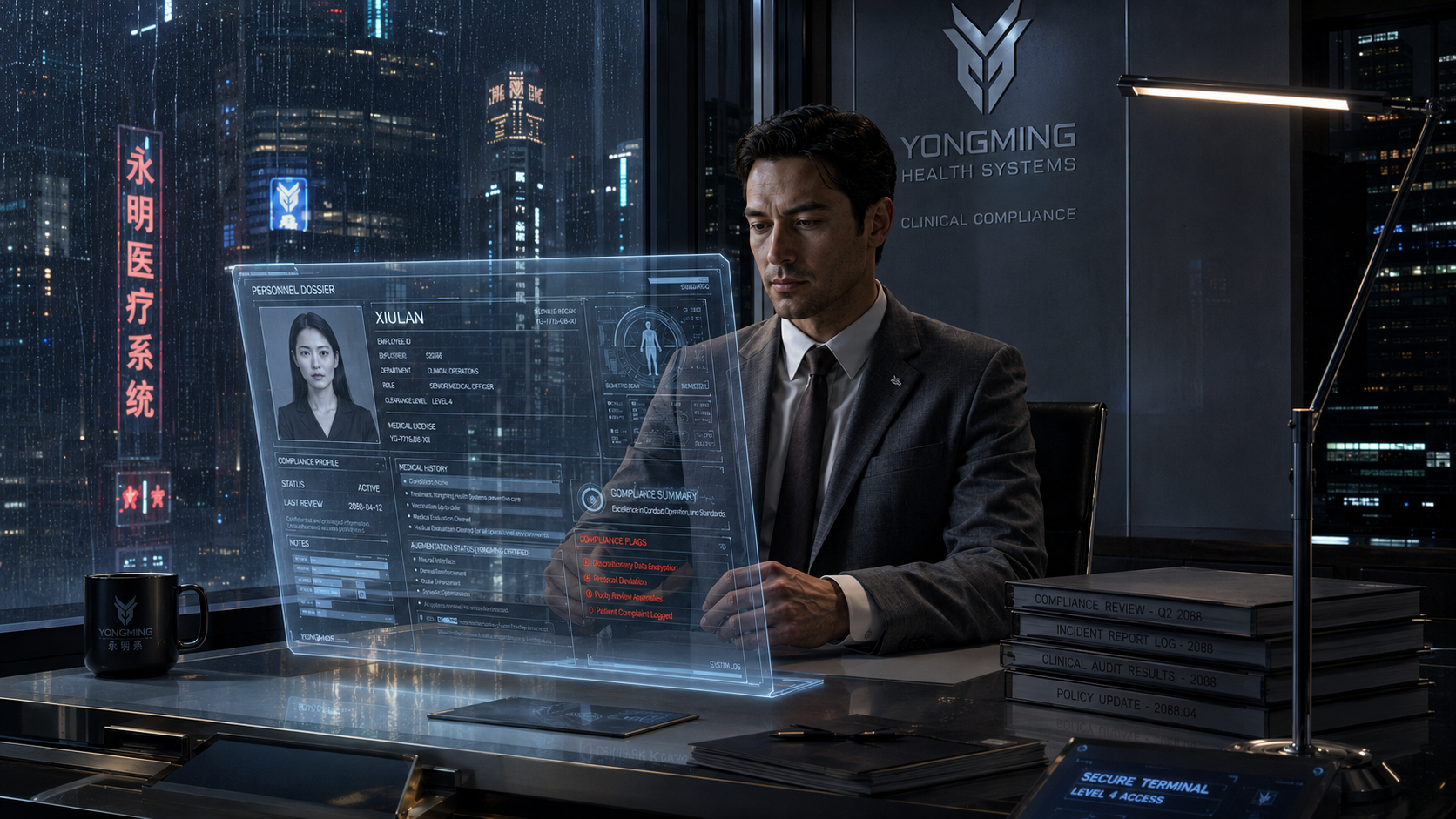
The third person sat slightly apart from the table.
Ressa Venn wore a field medic’s jacket rather than corporate clothing. Its reinforced fabric had faded across the shoulders, and one sleeve bore a pale stain that repeated cleaning had failed to remove. Silver threaded her close-cut hair. Two fingers on her left hand were synthetic, their joints scratched from use. She did not rise.

Her gaze travelled from Xiulan’s wet boots to the visitor badge, then to the leather satchel at her hip. It paused on Xiulan’s hands.Pell indicated the empty chair. “Please sit.” Xiulan bowed first to Pell, then Kelm, then Ressa. Kelm’s attention sharpened. “Is that a religious observance?” Xiulan straightened. “Sometimes.”
“What is it now?”
She felt the old pressure to select the answer least likely to displease. Her hands folded automatically before her. “Courtesy.” A small movement touched the corner of Ressa’s mouth and disappeared. Pell gestured again. “The chair, Xiulan.” Only then did Xiulan sit. Ressa noticed that too. The interview began with facts and encountered difficulties almost immediately.
“Your full legal name is Xiulan,” Pell said, reviewing the application on the glass surface before her. “No surname.”
“No.”
“Date of birth?”
Xiulan gave it according to the calendar she knew. Kelm entered the numbers. His display rejected them with a muted tone. “Place of registration?”
“Wak’An.”
“No matching civic authority exists under that name.”
“It existed.”
“When?”
Xiulan met his eyes, then lowered hers when the contact lasted too long. “This one does not know how your calendars counted those years.” Kelm made a note. His fingers produced almost no sound against the display. Pell continued before the silence could harden. “Your application states that you received medical instruction at the Palace of Wak’An.”
“Yes.”
“Was this an accredited institution?”
The word meant nothing in the context of a palace. Xiulan’s thumb traced the edge of one fingernail beneath the table. “This one does not understand.”
“Was the palace legally authorized to certify medical practitioners?”
“The palace authorized most things.”
Kelm’s expression did not change, but his hand stopped moving. “That is not what she asked.”
Xiulan’s shoulders drew a fraction closer together. “No. This one apologizes.” Ressa leaned forward, resting her forearms on her knees. “What did they teach you?” The question carried no visible trap. Xiulan turned towards her. “Herbs. Fever. Poisons. Birth. Wounds of blade, arrow and claw. Setting bone. Closing flesh. Cleaning rot. Returning warmth.” As she spoke, the catalogue became easier. Her hands loosened in her lap. “Recognizing when pain speaks falsely and when silence is dangerous.”
Ressa’s gaze lowered again to her fingers—the short nails, the pale scars, the stubborn stains left by roots and tinctures. “Who trained you?”
“Many Sisters.”
“Names?”
Xiulan’s breath caught so slightly that only someone already watching closely might have seen it. “Some should not be written.” Kelm looked up. “Why?”
“Names may be used to find people.”
“Are these people criminals?”
“No.”
“Then why would being found endanger them?”
Xiulan’s hand moved towards the satchel before stopping halfway. She folded it over the other instead, forcing stillness back into her posture. “This one does not know whether it still would.” The words left something unfinished in the room.
Ressa studied her for a moment longer, then asked, more quietly, “Can we contact any of them?”
“No.”
“Why not?”

Xiulan looked down at her clasped hands. The formal answer would have required fewer words. It would also have been false. “This one does not know where they are.” Nothing in her tone asked for sympathy. Pell’s gaze dropped to the application. Kelm resumed his notes. Ressa’s synthetic fingers tapped once against her knee and then went still. Pell changed direction.“You list no previous employer, although you worked in the palace infirmary.”
“Yes.”
“Were you paid?”
Xiulan glanced at her, uncertain where the difficulty lay. “This one was fed.” Pell’s lips pressed briefly together. “Were you given wages in exchange for your labour?”
“No.”
“Were you free to refuse assigned work?” The ventilation whispered overhead. Rain moved across the windows behind them, and somewhere beyond the wall a communications chime sounded twice. Xiulan’s spine straightened.
“No.”
Pell’s face softened by a degree. Kelm’s did not. “Were you enslaved?” The word struck cleanly because it allowed no polite misunderstanding. Xiulan raised her head. “No.” Kelm waited. She could feel Ressa watching her, not with pity but with the concentration she had shown towards Xiulan’s hands. “This one belonged to the palace,” Xiulan added. Ressa’s synthetic fingers stopped moving entirely. Pell leaned forward. “Those statements may mean the same thing here.”
“They did not mean the same thing there.”
“Were you permitted to leave?”
Xiulan turned her face towards the rain. Her reflection hovered faintly in the glass, superimposed over the upper districts of Neo-Peltarch.
“No.”
Pell allowed a silence to pass before asking, “But you did leave.”
“Yes.”
“How?”
Xiulan’s eyes remained on the window. Her jaw tightened once before the discipline of her expression restored itself. “This one survived leaving.” Kelm entered another note. Ressa did not look at his display. They asked about healing magic next. This interested Compliance more than herbs. “Your intake assessment references divine intervention,” Kelm said.
“This one did not use those words.”
“The clerk categorized your description.”
Xiulan inclined her head, accepting the distinction without agreement. “This one petitions.”
“To which registered deity?”
“The proper office.”
Kelm waited, his stillness turning the incomplete answer into pressure. Xiulan drew a careful breath. “Office of Wound. Office of Returning Breath. Office of Blood Remaining Within Its Roads. Grave offices, when the dead have forgotten courtesy.” Pell glanced towards Kelm. Ressa looked down, and Xiulan saw her press her tongue briefly against the inside of one cheek. Kelm’s voice remained level. “You believe medical functions are administered by separate supernatural bureaucracies.”
“The word ‘bureaucracy’ is unkind.”
Ressa covered a sound with a cough. Her eyes, when she raised them again, carried a brief brightness that had not been there before. “Can these effects be reliably reproduced?” Kelm asked.
“No.”
“Then they are not clinically dependable.”
“This one did not say they were.”
“What happens when these offices refuse your petition?”
Xiulan’s answer came more easily. “Clean water. Pressure. Thread. Heat. Medicine. Herbs. Time.”
“And when those fail?”
Her gaze moved to the scar across Ressa’s knuckles and then to the faded stain on her sleeve. “This one stays.”
Ressa’s posture changed. The casual angle left her shoulders. She leaned forward fully now, forearms resting on her thighs, and for the first time Xiulan felt that the field medic was no longer merely observing the interview. Pell reviewed the application again. “Why Yongming?”
Xiulan looked through the interior glass towards a suspended walkway joining two hospital towers. Staff crossed it carrying sealed cases and diagnostic equipment, their movements purposeful without being hurried. “There are wounded here.”
“There are wounded everywhere,” Kelm said.
“Yes.”
“Then why this hospital?” Xiulan considered inventing an answer that would sound more worthy. Instead, she allowed the truth to remain plain. “This one was told you were hiring.”
Ressa laughed. It was brief, low and without cruelty. Pell lowered her eyes towards the table, though the corners of her mouth changed. Kelm remained unmoved. “Do you understand what employment entails?” Pell asked.
“No.”
The answer came too quickly. Xiulan felt the mistake only after it had left her. Pell did not reprimand her. “Then why apply?” Xiulan looked down at her hands. They knew work. They knew how to clean blood from stone, how to grind bitter bark, how to hold a fevered child while someone else slept. They had performed duties before she understood what duty meant. “Because this one understands work.”
The alarm began as a vibration beneath the table. A moment later, the white lighting along the walls changed to amber. Pell’s identification mark illuminated. Ressa was standing before the announcement began.
“Mass casualty protocol,” said a calm voice from the ceiling. “North Transit Loop derailment. Forty-three confirmed casualties. Electrical fire and structural damage. Emergency receiving teams report immediately.”
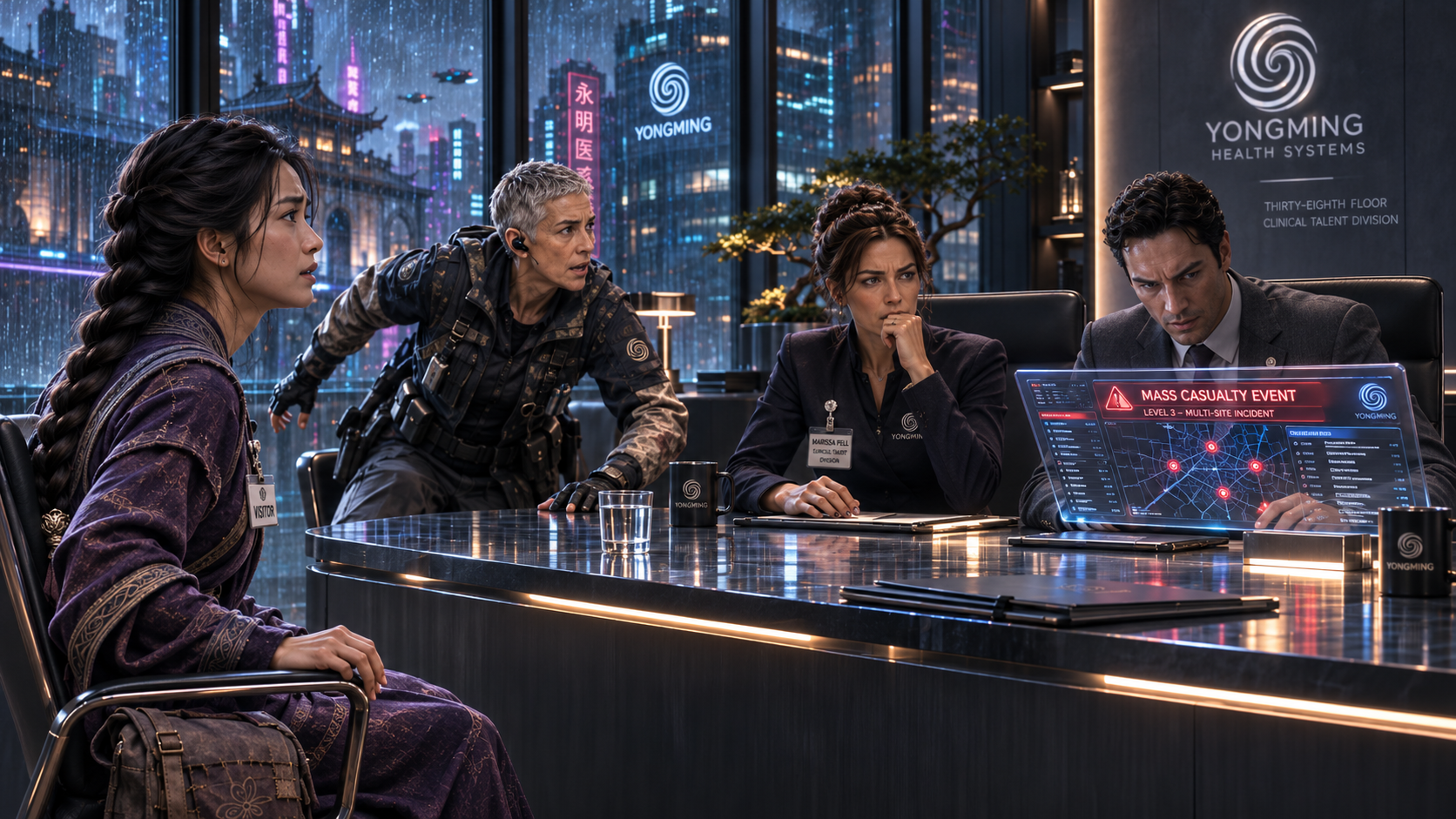
Beyond the glass, the hospital transformed. People who had been walking began to run. Wall panels opened to reveal equipment racks. Directional lights spread across the floor, guiding teams towards the lifts. Staff fastened jackets and pulled gloves over their hands without interrupting one another. Ressa was already at the door.Pell rose, gathering her display. “We’ll have to suspend this.” Xiulan stood with them.
Kelm looked towards her chair. “You will remain here.” Her body stopped before her thoughts did. “You are not an employee,” he continued. “You are not licensed, insured or authorized to enter a clinical response area.” Xiulan folded her hands at her waist. “Yes.”
“Do you understand?”
She looked towards the corridor, where two nurses ran past carrying oxygen equipment.
“Yes.”
Ressa paused at the open door. Their eyes met. No invitation appeared in the older woman’s face. Her jaw was set, her attention already moving towards the emergency below. Then she was gone. Pell and Kelm left moments later. The door closed.
Xiulan remained beside the chair while amber light pulsed softly through the empty room. Through the glass, she watched teams move past with stretchers, sealed packs and equipment cases.
She counted thirty-seven breaths. On the thirty-eighth, an orderly stumbled outside the interview room. A trauma case slid from the stack in his arms and struck the floor with a heavy metallic crash. He bent awkwardly, trying to recover it without dropping the others. Xiulan opened the door. The corridor light crossed the threshold. She lifted the case. “Where?”
The orderly hardly looked at her badge. Sweat shone along his temple. “Emergency intake. Lower receiving.” He turned and hurried towards the lift. Xiulan followed. The decision was so small that it did not feel like disobedience until the doors closed behind her.
-
Foreword Video: https://youtu.be/RsW8DiPrEKI
